

An algorithm built with ChatGPT-like technology predicts more than 1000 health conditions – something that could help doctors to provide better care for their patients.
Summary
An artificial-intelligence (AI) algorithm creates surprisingly accurate health forecasts. The system, which uses technology similar to ChatGPT, can predict more than 1000 diseases up to two decades in advance. In the future, AI companions could help GPs to better spot and support patients with particular ‘disease forecasts’.
An artificial-intelligence (AI) algorithm can predict which diseases someone will develop over the next 20 years. The AI system, dubbed Delphi, can forecast chances of more than 1000 diseases simply by looking at someone’s medical history.
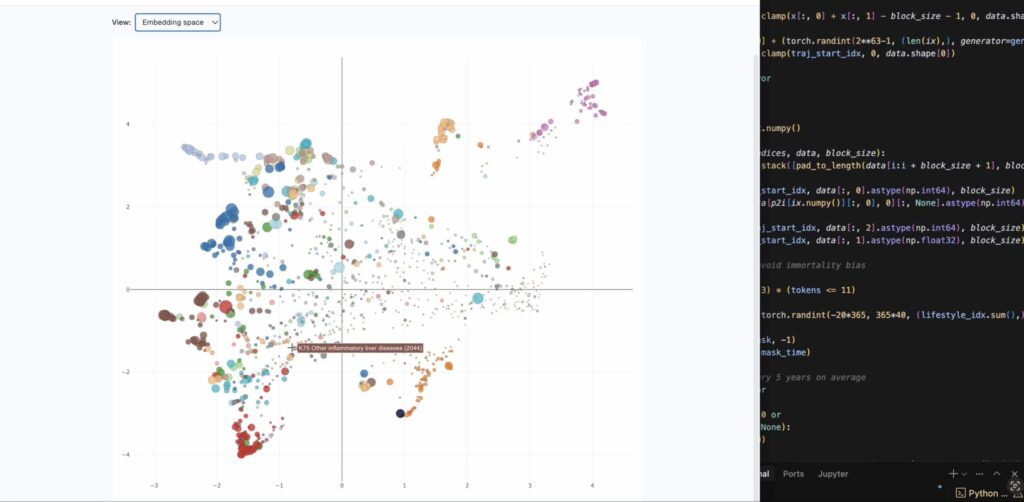
Delphi is a modified large language model, similar to ChatGPT, Google Gemini and Microsoft Copilot. While these AI chatbots learned vocabulary and grammar from huge amounts of text, Delphi learned the language of health and disease from the information provided by more than 400,000 UK Biobank participants.
The most obvious application would be as an early warning system.
Tomas Fitzgerald, European Molecular Biology Laboratory, UK
“The most obvious application would be as an early warning system,” says Delphi co-creator Tomas Fitzgerald from the European Molecular Biology Laboratory in Hinxton, UK.
It could help doctors to spot patients that are at high risk of a disease and offer them additional check-ups or preventative treatments. It could also forecast the health needs of an entire country, to make sure there will be enough specialists, medication and equipment.
What Delphi gets right – and wrong
Delphi is best at predicting diseases that progress with clear patterns, such as dementia, heart attacks and blood poisoning. It’s less useful for viral infections and rare inherited disorders.
It shows you that it’s not about collecting more data, it’s about using models that extract the right knowledge from the data.
Professor Alejandro F Frangi, University of Manchester, UK
Similar to weather forecasts, Delphi’s short-term predictions are better than its long-term ones, though it depends on the disease. “Cancers are more difficult to predict longer term, whereas heart conditions are easier,” Fitzgerald explains.
Delphi only needs some basic information, including sex, age and medical history. Yet its forecasts seem to be at least as good as those of the risk-prediction tools doctors use, which often require blood tests and other information. “It shows you that it’s not about collecting more data, it’s about using models that extract the right knowledge from the data,” says computational medicine specialist Alejandro Frangi from the University of Manchester, UK.
Putting the algorithm to the test
What makes Delphi different from similar AI algorithms is that it looks at more than 1000 diseases at once to capture complex interactions between them. “This is something that has never been done before, or at least not with the level of detail,” Frangi says.
He’s also impressed by the thorough testing Delphi was put through when it was asked to make predictions for the around 1.9 million people in the Danish National Patient Registry. Even though these people are from a different country and live with a different healthcare system, Delphi’s predictive power was almost as good as for UK Biobank participants.
How Delphi would perform for people who are very different to the mainly white European UK Biobank population “is an open question”, Fitzgerald says. “I’d be confident to say it would perform better than current disease models.”
The future of predicting the future
I would see it being used to help clinicians to understand and to put in context the health history of an individual. Maybe there are diseases that the clinician hadn’t really thought about.
Tomas Fitzgerald, European Molecular Biology Laboratory, UK
It will likely take quite a few years until something like Delphi is ready for clinics. Frangi would like to see how the algorithm does when it has access to other information – including scans and blood tests – that are usually part of someone’s medical record.
There are also ethical questions that need to be addressed, says Frangi. For example, how would people feel about knowing that they might develop a condition that can’t be prevented or cured?
Eventually, AI companions could act as a sounding board for GPs’ medical intuition. But while intuition can depend on whether a doctor is tired, less experienced or seeing a patient for the first time, “these techniques provide the ability to respond similarly in any circumstance”, Frangi points out.
The team is now testing whether giving Delphi more data – such as genetic or blood test data – could make its predictions even better. Both Frangi and Fitzgerald point out that without UK Biobank participants, Delphi wouldn’t exist. “I hope this sort of work will confirm to funders the importance of UK Biobank,” Frangi says.
Related publication
- Nature, September 2025

