
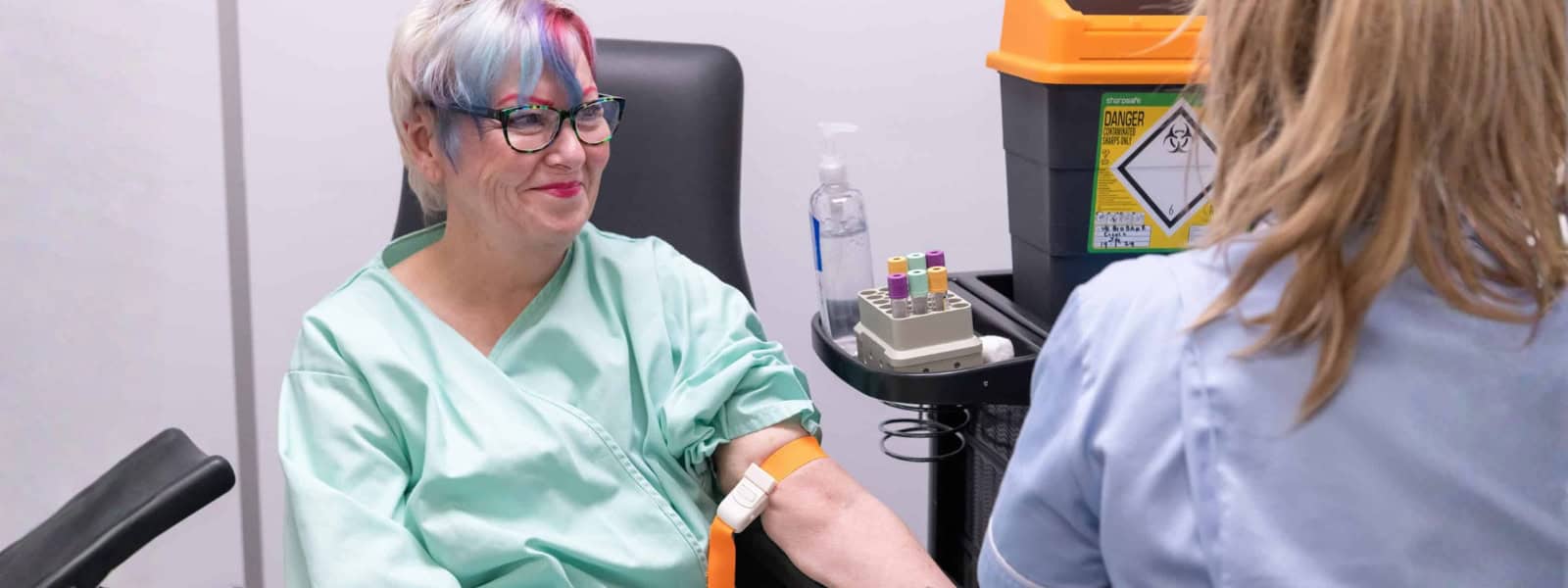
Test that distinguishes the debilitating condition from other diseases could spare many people a long, uncertain path to the correct diagnosis.
Summary
A new blood test can tell if someone has motor neurone disease (MND); a progressive and ultimately fatal condition. It could reduce the large number of people who are initially misdiagnosed, which delays their treatment. Researchers who analysed blood samples, including those from nearly 24,000 UK Biobank participants, discovered MND’s distinct ‘biological fingerprint’: certain biological compounds that can even warn of the disease years before symptoms appear.

Nearly 24,000 samples from UK Biobank participants have helped developed this blood test
A blood test, developed with the help of samples from nearly 24,000 UK Biobank participants, can spot if someone has motor neurone disease – even if they don’t have any symptoms yet or if their symptoms are too vague to pin down the deadly condition. This could reduce the high rate of misdiagnosis, currently around 40%, which delays getting patients the right care and treatment.
The long road to diagnosis
Motor neurone disease (MND) is a debilitating and ultimately fatal condition affecting some 6,000 people in the UK. Over time, it destroys the cells that transmit signals from the brain and spinal cord to the muscles. Eventually, it affects the muscles needed for breathing. How fast this happens varies from person to person.
Studies have shown that the delay to get an accurate diagnosis is anywhere from six months to 18 months.
Ruth Chia, National Institutes of Health, US
Getting a diagnosis usually involves a battery of tests and a lengthy process of elimination. “Studies have shown that the delay to get an accurate diagnosis is anywhere from six months to 18 months,” explains Ruth Chia from the US National Institutes of Health. “That’s a long time, given that the survival [from the onset of symptoms] is three to five years – that’s half the time.”
MND’s early signs can be subtle and mimic other conditions. For example, people often experience muscle weakness in the arms and legs early on, which can be misinterpreted as a sprain or slipped disk. Around 40% of people with MND initially get diagnosed with something else and a little more than 10% even get unnecessary surgeries because of this.
MND’s biological fingerprint
Chia and her colleagues discovered that certain proteins – biological compounds made by our bodies – act as a warning signal for MND. They show up in unusual amounts in the blood of people who have MND, but not in the blood of healthy people or of those who have other neurological conditions.
A blood test can pick up MND’s protein signature many years, sometimes more than a decade, before the condition is ultimately diagnosed. “We had always assumed that ALS [amyotrophic lateral sclerosis, the most common type of MND] was a rapid disease that starts 12 to 18 months before symptom onset,” Chia’s co-investigator Alexander Pantelyat from Johns Hopkins University, US, said in a statement. “But when we look at our findings, we see this has been a process that goes on for a decade or so before the patient ever steps into the doctor’s office or clinic.”
We’re on the verge now of some effective treatments – so the quicker somebody can be diagnosed, the quicker they can get onto a medicine.
Dr Nicholas Cole, Head of Research, MND Association
“This is where we got really excited,” Chia recalls. “If we are able to diagnose somebody using a blood-based test that says that you are at high risk of getting the disease in maybe five to 10 years’ time, we could start monitoring certain things. Treatment could be initiated much earlier.”
Although there’s no cure for MND, “we’re on the verge now of some effective treatments – so the quicker somebody can be diagnosed, the quicker they can get onto a medicine”, explains Nicholas Cole, head of research at the MND Association.
Cole calls the new research “promising”: “If there is a biomarker or a test that’s accurate, that will be a significant positive for the community and treating people.”
Related publication
Related publication
- Nature Medicine, August 2025

