As UK Biobank’s record-breaking project crosses the finish line, researchers are working to reveal what the images can tell us about why we get ill as we age – and what to do about it.
Summary
UK Biobank has collected the brain, body and bone scans of 100,000 volunteers. The images have reshaped how dementia is diagnosed in some NHS clinics and have revealed insights such as how COVID-19 changes the brain. Scientists have now set their sight on understanding stages and variations of common diseases and uncovering hidden links between seemingly unrelated conditions – all with the goal of keeping us healthy as we age.
“Just mind-blown,” says neuroscientist Clare Mackay from the University of Oxford, UK, about UK Biobank reaching one of its biggest and boldest goals: collecting brain, body and bone scans of 100,000 participants. It’s the world’s biggest whole-body imaging project, more than three times larger than any current project of its kind.
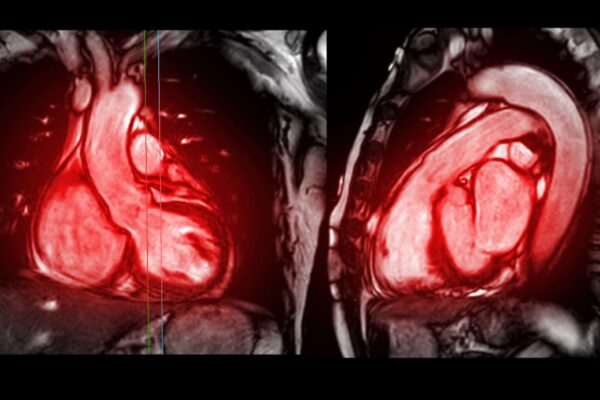
The images have already revealed insights such as how COVID-19 damages the brain, how noise from airports threatens heart health and how to spot liver disease without an invasive biopsy. The project is also reshaping clinical practice: 12 clinics in the UK have started to use UK Biobank’s brain-imaging processes to diagnose dementia more accurately.
Altruism of 100,000 people
I’m glad to be one of the 100,000. The data is critically important. We’ve contributed to research, and it hasn’t cost us anything beyond a bit of minor inconvenience.
Alan, UK Biobank participant
Reaching this milestone has taken more than a decade, with each participant donating many hours of their time. “I’m glad to be one of the 100,000,” says UK Biobank participant Alan. “The data is critically important. We’ve contributed to research, and it hasn’t cost us anything beyond a bit of minor inconvenience.”
“UK Biobank’s imaging dataset is unrivalled, nothing comes even close anywhere in the world,” Mackay says. “It’s an incredible resource, but the value of it isn’t just in its size, it’s in all of that other data [such as genetic information and medical histories] that gets collected at the same time.”
Like other researchers, Mackay is excited to uncover what the scans from 100,000 people – more than a billion images in total – can tell us about how and why we get ill as we age, and what to do about it.
A bold vision
“In 2007, I got a phone call from Rory Collins, out of the blue, and he casually asked the question: ‘Stefan, can we do a study with scans in 100,000 people?’,” recalls Stefan Neubauer from the University of Oxford who is part of an expert group supporting the project. “My spontaneous thought was that it was completely impossible, but I was intrigued.”
“UK Biobank’s imaging dataset is unrivalled, nothing comes even close anywhere in the world.
Professor Clare Mackay, University of Oxford, UK
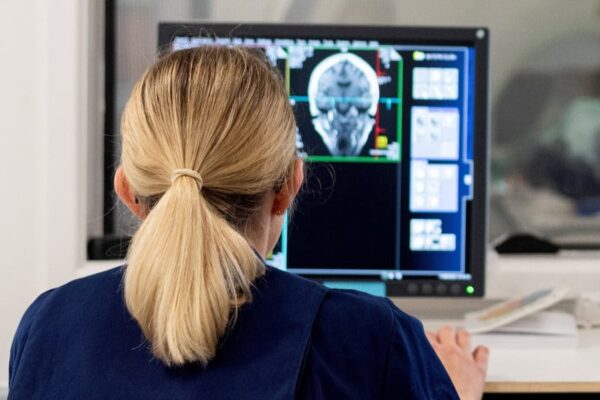
At the time, nothing even remotely similar in scale had ever been attempted. Coming up with a way to squeeze four scans – two magnetic resonance imaging (MRI), a whole-body x-ray (DEXA) and an ultrasound scan – into a single visit was a challenge. MRI scans in particular can take hours only to get a handful of good images. UK Biobank’s team designed a completely new process that takes less time but still produces high-quality images.
Reshaping dementia diagnosis
Mackay calls UK Biobank’s imaging “one of the most exciting innovations over the last 10-20 years in imaging research”. In 2022, she was part of the team that introduced the brain-imaging process at the Oxford Brain Health Clinic, which treats people with dementia and other memory problems.
Many similar clinics use computed tomography (CT) instead of MRI scans because they are faster, but they also give lower-resolution images. Taking an MRI with UK Biobank’s imaging process takes only 15 minutes, which is one of the reasons the Oxford clinic and 11 other NHS memory clinics started using it in the last few years.
The higher-quality MRI images allow clinicians to better distinguish dementia from other conditions, Mackay explains, and to identify the type of dementia, for example Alzheimer’s disease. Accurately diagnosing the condition is crucial for offering the right treatment – and will become even more important as researchers develop new medications for specific conditions.
Pandemic discovery

More than 1,300 scientific studies have already used the images to investigate conditions ranging from heart disease to osteoporosis
More than 1,300 scientific studies have already used the images to investigate conditions ranging from heart disease to osteoporosis. One study that stood out to many: in 2022, MRI scans of 800 UK Biobank participants proved that even mild COVID-19 infections damaged parts of the brain responsible for the sense of smell.
“I think for a lot of people that spoke to validating their experience,” says neuroimaging researcher Karla Miller from the University of Oxford, a member of UK Biobank’s imaging project expert group who was part of the COVID-19 study team.
She was proud to contribute to the global research effort at a time when many were struggling. UK Biobank already had pre-pandemic brain scans, which gave scientists the unprecedented opportunity to compare before-and-after images of people who had caught the virus. “We were just absolutely poised [to do this work] in a way that few other places or studies would be”, Miller says.
From rare diseases to everyday risk
Having scans from 100,000 people – rather than, say, only 50,000 people – will allow scientists to better understand rare diseases, explains neuroimaging researcher Vaanathi Sundaresan from the Indian Institute of Science in Bangalore. She is investigating siderosis, a rare and currently incurable condition in which the body accumulates harmful iron in the brain.
The huge number of images also means that common health conditions are represented with their “full, complex, messy, subtle set of features”, says Miller. This makes it possible to pinpoint who is at risk of diseases, spot disease signs earlier and predict how conditions will progress.
Mackay and her team are working on the first reference chart for the adult brain – a set of images, created from UK Biobank scans, of what healthy brains look like at different ages. This would allow clinicians to compare patients with a healthy average, pinpoint problems and offer tailored treatments.
The enormous dataset also lets researchers find hidden links between seemingly unrelated conditions, dementia and diabetes for example. Key to this is collecting images of multiple organs from each participant, says Sundaresan, not just the organ that is affected by a disease.
The next chapter
“100,000 is not the end by any means,” says University of Oxford’s Paul Leeson, who is part of UK Biobank’s imaging project expert group. Every participant who attended an imaging visit will be invited for a second one. 13,000 have already attended a second visit, with the goal to re-scan 60,000.
100,000 is not the end by any means.
Professor Paul Leeson, University of Oxford, UK
Comparing scans taken years apart is an amazing opportunity to find out what happens in our bodies as we get older, and how changes to our diet and exercise, for example, impact our health, suggests imaging researcher Louise Thomas from the University of Westminster, UK. Repeat images will give scientists unique insight into how conditions develop and progress – and find ways to spot them in their earliest stages.
“If I were invited for re-imaging, I would certainly say yes,” says UK Biobank participant Alan.